Self-blame Spiral- why & why it matters

Why do we spiral into self-blame and regret? Why does it matter? And what can we do about it?
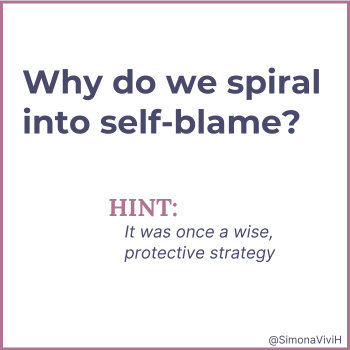
Self-blame was once a brilliant protective strategy. If our adults hadn’t yet done their work, and if they didn’t have the capacity to hold complicated things with us…
Then when life was lifing (as it does), we were on our own. Even as children.
Figuring out how it was our fault would have given us a sense that we have some agency. Which, for our younger selves, would have meant that the future didn’t have to feel terrifying. Because if it was our fault, then if we figured “it” out, whatever “it” may be, then we could do something about it.
Why Self-Blame was Adaptive
Back then, self-blame was adaptive agency. But, self-blame as an adult comes with a much higher cost.
When we are young, “paying” for belonging with our adaptations makes sense. We depend on our caregivers for survival at that age, and we have very little choice. Consider this: as an adult, have you ever had a hard conversation with your parent result in drama? How ease or hard was it? How well was it received?
If you are the adult child of an emotionally immature parent, you may have been met with defensiveness, no matter how carefully you phrased it. (Here’s a clip of Simona & Dr. Lindsay Gibson talking about the classic ‘deny, dismiss, distort’ defense)
Now, imagine being a young child and being met with that reaction.
Which is why, it would have made sense to adapt, even if it came with a cost. But, as adults, we have more choices available to us, because we have more resources at our disposal than we did when we were children. So, then we need to look at the cost.
What’s the Cost of Self-Blame?
When we speak to ourselves harshly, we are sending excitatory neurochemicals to our brain, which leads to our internal community members (between our two ears) becoming stirred up in what’s known as a non-integrated state. What that means from a practical standpoint is that we aren’t able to access our best solutions.
The cost of self-blame includes less optimal solutions, AND it also impacts how we are showing up for the people we love most in this world. Notice: have you ever found yourself being short with someone you love under stress? If so, welcome to being human. It’s cringe-y that we do that at times, but when we notice the pattern, we can do something about it.
What we can do once we notice the pattern
Once we spot it, we have more choice.
One of the fastest tools we can reach for is the remothering moment. That’s when we greet ourselves with an “of course”, and then rather than lighting our brains on fire with harsh self-talk, self-blame, or regret, we can send soothing neurochemicals from us to us. Something as simple as putting our hands on our hearts and saying, I’m here, can change our physiology and bring us to more harmony between our ears. And, when we greet ourselves warmly, our brains cool-down, we have more choice, and more access to our inner wisdom.
It sounds simple because it is. But, as we all know, simple doesn’t always mean easy. Sometimes those well-worn patterns of self-harshness take practice to re-route. Fortunately, neuroplasticity is on our sides!
Here’s to the tools, and to the RELIEF and ease that comes with knowing them!
May the harmony we are each learning to cultivate between our own two ears ripple out into the world in positive and meaningful ways.
More Resources
On the Blog
- What were you thinking tree?
(the tree isn’t spiraling into self-blame, why are we?) - Recognizing Adaptive Patterns and Unlocking Freedom
- Ever get caught in the vortex of harsh self-talk?
Services
Sometimes the insights on their own are enough. But when they aren’t, you don’t have to do this alone. When the wound was relational, at some point on the journey, part of the healing will also be relational as we learn & practice new skills, tools, and relational choreography.
Would it have been nice to learn foundational skills when we were children? OF COURSE. But if we didn’t (I’m raising my hand here too), then at least we can be glad they are learnable skills.
- Healing mother wounds; healing ourselves; reparenting; remothering
Click here for programs and services - Parenting as you are healing
If you are also parenting while you are doing your healing work, learning new skills, AND facing those cringe-y moments of realizing you may have already leaked some of your unhelpful generational patterns onto your kid(s) despite your best efforts and intentions, you are not alone. And thankfully, it’s not too late. No matter how old your child is. Click here for resources and services.
